
How a lumberjack became a giant
Paul Bunyan belongs to a world of towering pines, frozen logging roads and long winter evenings in the North Woods. Early tales circulated among lumber workers, where exaggeration and practical jokes turned the hazards of camp life into stories of almost impossible strength and ingenuity.
As the stories grew, Bunyan grew with them. He could fell trees by the acre, move mountains, and remake entire landscapes with the help of Babe the Blue Ox. The scale is deliberately absurd; that is part of the pleasure of American tall tales.
From camp stories to a national image
The tradition developed over time rather than springing from a single author. References to Bunyan appeared in print in the early twentieth century, after years of oral storytelling. A turning point came in 1914, when William B. Laughead created promotional material for the Red River Lumber Company. His illustrated version helped carry Bunyan from regional stories into national popular culture.
That printed identity matters. Paul Bunyan became more than a folk character: he was also an early example of how commercial illustration and advertising could shape the appearance of an American legend. His familiar visual identity was not a surviving nineteenth-century photograph of a real giant, but the product of stories, artists and publishers.
A logging-camp portrait that never existed
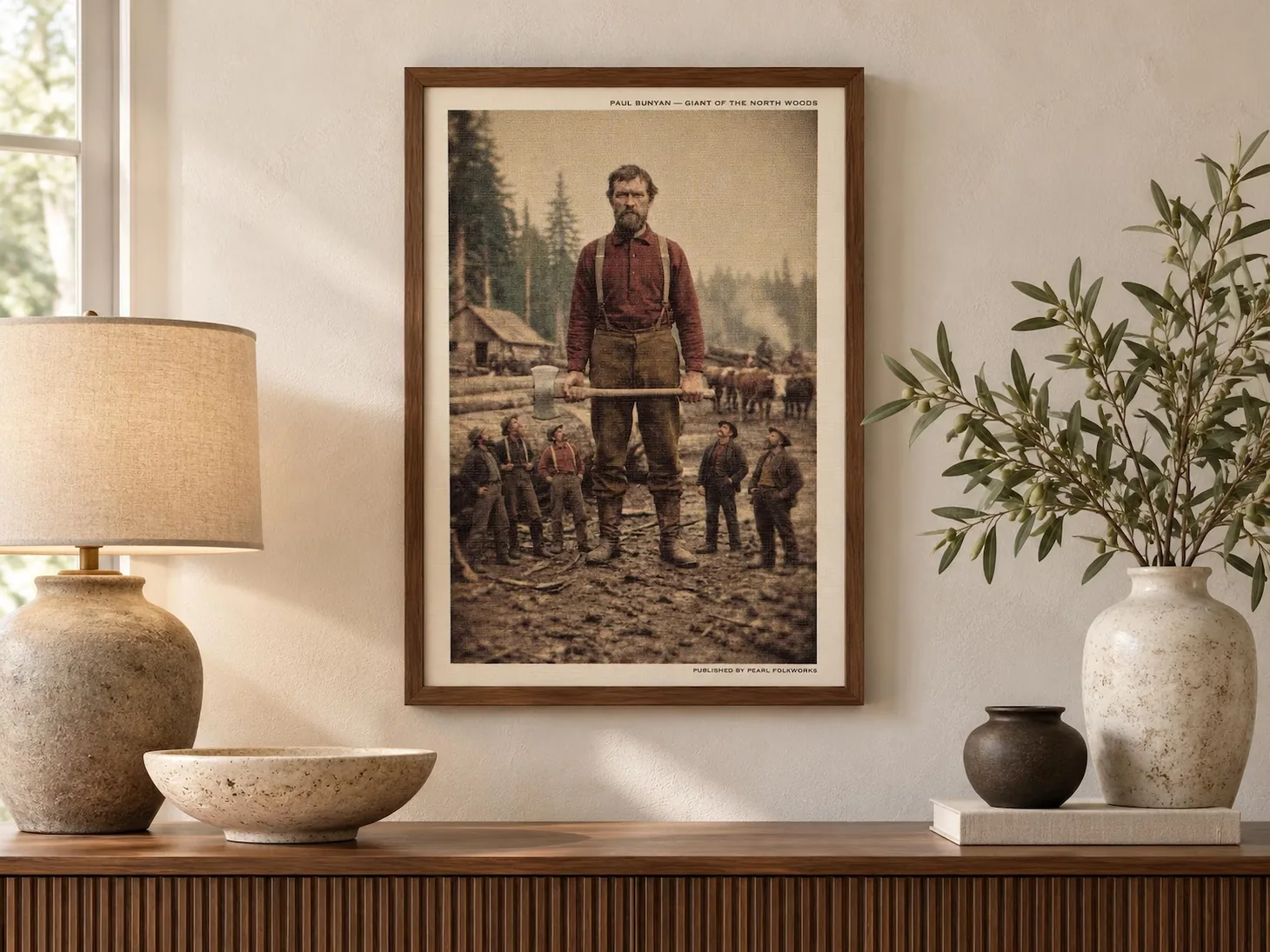
The Pearl Folkworks interpretation imagines a staged logging-camp portrait: Bunyan stands with an axe while ordinary woodsmen appear much smaller beside him. The imperfect, hand-colored, vintage-photograph quality is intentional, connecting a fantastical tale with the visual language of early American print culture.
Made as contemporary Americana wall art, the piece is intended to feel like a curiosity discovered in an old regional collection—an invented artifact celebrating the imagination of American folklore, not a genuine archival photograph.
Historical sources and further reading
These institutional resources informed the historical background. The artwork shown above is a modern artistic interpretation, not an archival image.