A man, a hammer, and a machine
In the American ballad tradition, John Henry is a powerful steel-driving worker building a railroad tunnel through solid rock. Steel drivers used hammers to strike long steel drills into stone, opening holes for blasting charges. It was dangerous work, performed by crews whose labor transformed the nineteenth-century American landscape.
The familiar story places John Henry in a contest with a steam-powered drilling machine. He drives steel faster than the machine, wins the contest, and collapses from the effort. The ending gives the ballad its emotional force: remarkable human skill measured against industrial machinery, at a terrible personal cost.
The history behind the legend
Researchers have searched for a historical John Henry for decades. Many versions connect the story to railroad tunneling in the 1870s or early 1880s, particularly the Chesapeake and Ohio Railway and its related construction projects. Suggested settings include the Big Bend Tunnel in West Virginia, tunnels in Virginia, and sites in Alabama. There is no scholarly consensus about exactly where the legendary contest occurred—or whether it happened as the song describes.
John Henry is especially significant within the history of Black labor. Versions of the ballad and later interpretations remember the strength, skill and sacrifices of African American railroad workers whose contributions were often left unnamed in formal histories. The narrative has lived on through work songs, recordings, literature and visual art.
Interpreting John Henry in print
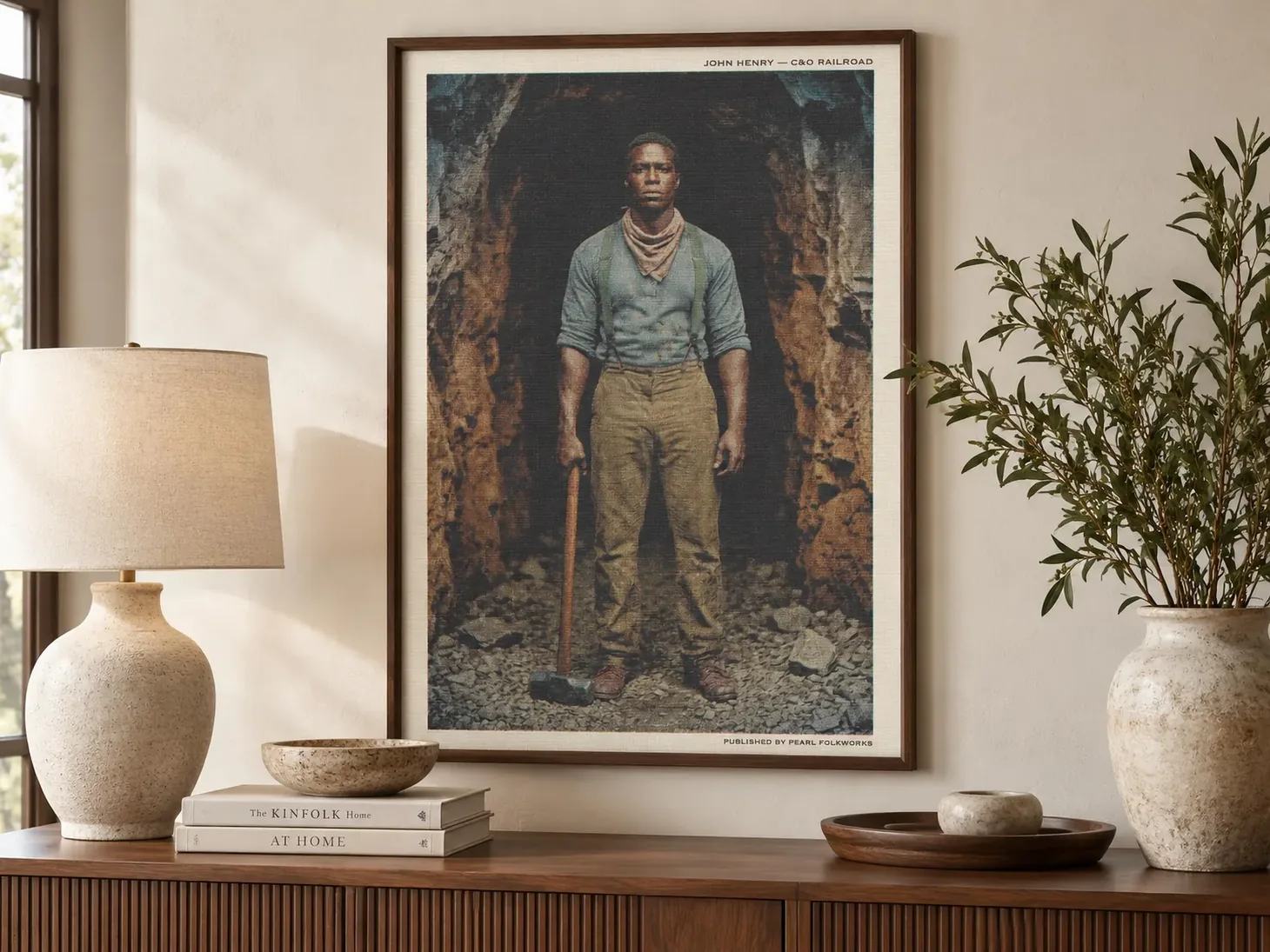
The Pearl Folkworks image presents John Henry as a full-length figure standing with his hammer before a railroad cut. Rather than attempting to reconstruct a verified historical photograph, the composition draws on the atmosphere of old portraits and vintage American printed ephemera. It is a contemporary interpretation of a legendary subject.
In a room, the print works both as historical Americana wall art and as a reminder of the human stories behind railroad expansion. The image gives the folk hero a still, dignified presence rather than depicting the contest itself.
Historical sources and further reading
These institutional resources informed the historical background. The artwork shown above is a modern artistic interpretation, not an archival image.